Stock in Focus: Netflix Inc (NASDAQ:NFLX)
 CommSec
17 February 2026
Netflix has never produced a drama quite like its battle to acquire Warner Bros Discovery – but how will this show end?
From groundbreaking shows to euphemistic phrases, Netflix is nothing if not ubiquitous. So just how did a company whose business model was once predicated on snail mail become – well, Netflix – and what lies ahead for the content behemoth?
Previously, on Netflix…
Before it was the world’s biggest streaming company, Netflix began life in 1997 as a mail-based rental business in which it would post DVDs out to customers to watch and then mail back to Netflix.
Almost 30 years, one public listing and a complete business model overhaul later, Netflix’s relatively simple modern-day value proposition involves only one business, its streaming service. It has an extensive TV entertainment subscriber base in both the US and the collective international market, with around 325 million subscribers globally.1 With exposure to nearly the entire global population outside of China, Netflix has traditionally avoided a regular slate of live programming or sports content, instead focusing on on-demand access to episodic television, movies, and documentaries.
“Netflix… [avoiding] the temptation to bid for a regular slate of major live sports programming… has been wise, considering our view that it would’ve had to overpay to attract major sports leagues,” argues Morningstar.2 “It has also chosen to grow organically from the ground up, building its business with no head start in terms of content ownership or foothold in the traditional media business.
“These decisions now give Netflix the advantage of not having to manage a declining legacy business, and it isn’t burdened with expensive sports contracts or a subscriber base that is dependent on retaining sports rights.”
The company introduced ad-supported subscription plans in 2022, exposing Netflix to the advertising market in addition to the subscription fees that have historically accounted for nearly all its revenue.3
Netflix vs Paramount
In recent months, Netflix has been a key player in a takeover battle that could potentially redraw the landscape of the American film and television industry.
On 5 December 2025, the company announced it would be acquiring most of Warner Bros Discovery (NASDAQ:WBD), one of the biggest names in traditional moviemaking and owner of big-name entertainment brands like HBO, DC Comics, Discovery Channel and Warner Bros Pictures (among many others), in a deal valued at US$83bn. But on 8 December, Paramount, the longest operating Hollywood film studio,4 appealed directly to Warner’s shareholders to accept an alternative offer of US$108bn for the whole company, promising a deal that would be ‘superior to Netflix in every dimension’.”5 Netflix responded by sweetening its offer with an all-cash deal.6
Where Paramount is currently offering US$30 per share for all of Warner, Netflix is offering US$27.75 for just its streaming platform and studios, allowing Warner shareholders to hang on to the firm’s TV and cable networks.7 Morningstar believes “there is less than a 50% chance Netflix acquires Warner, considering Paramount’s aggressive interest. If Netflix does acquire Warner for the US$27.75 per share that it offered, we think it would be slightly value-destructive for Netflix”.8
Impact on Netflix stock
The ongoing battle between Netflix and Paramount for custody of WBD certainly hasn’t gone unnoticed by the market. Netflix’s share price closed at just over US$100 on 5 December 2025; since then, it’s fallen by around 20% to land at US$79.62 on 11 February 2026.9
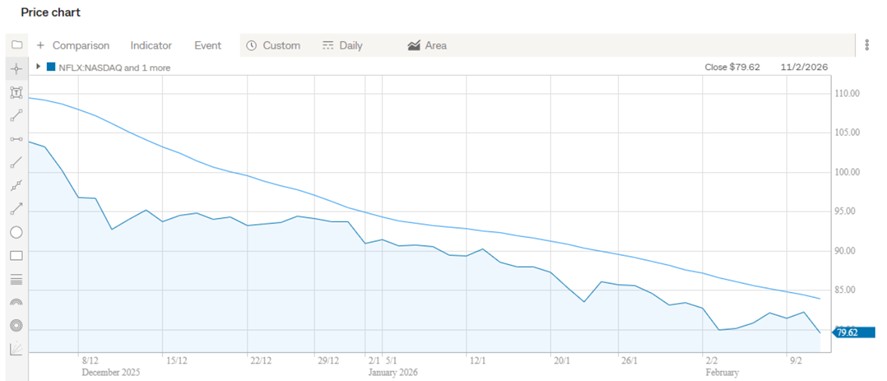
Source: CommSec, as of 11/2/26.
Nevertheless, Netflix's fourth-quarter revenue for the 2025 calendar year rose 17% year over year (excluding currency tailwinds).10 For the full year, revenue also increased 17%, and the operating margin expanded 3 percentage points, to 29.5%.11 Net income for the fourth quarter was US$2.42 billion, or 56 cents per share, up from US$1.87 billion, or 43c per share, during the same period a year earlier.12
“Netflix is the leading streaming television platform globally and enjoys the economic benefits of market-leading scale. We expect this position will persist,” says Morningstar.13
“Assuming no huge misfires that result in a lack of attractive programming over an extended period, we expect Netflix’s subscriber base to be sticky, and we think the cash it generates will allow it the capacity to produce many new series and movies each year, giving ample opportunity for customers to find something they like.”14
On the bearish side, however, Morningstar also warns that Netflix still “face[s] threats. Notably… a much more robust streaming market than it did when it was establishing its dominance while charging relatively low prices. With many subscription streaming platforms offering popular content, we don’t believe consumers will have the financial willingness or ability to subscribe to all, meaning Netflix will need to continue offering a robust amount of attractive programming to maintain its position.”
The consensus view
"Consensus: Outperform" in stock trading means the average sentiment among a handful of financial analysts is that a stock will perform slightly better than the overall market or its sector peers over a specific period.

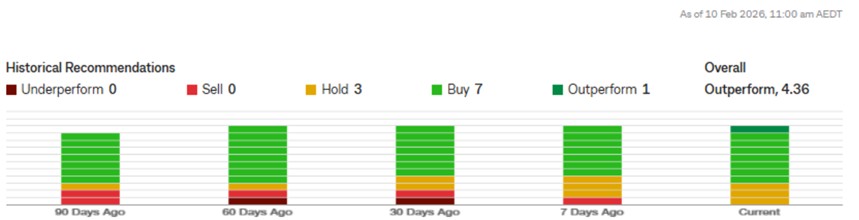
Source: CommSec, accessed 10/2/26.